
What Is a Security Assessment for Commercial Buildings?
Key Takeaways
A commercial security assessment is a structured evaluation of how well a building's systems, procedures, and design work together under real conditions. It is not a product recommendation, a compliance checklist, or a sales presentation.
Assessments examine site and perimeter vulnerabilities, access control and internal movement, surveillance coverage, emergency procedures, and how these elements interact as a system rather than in isolation.
The presence of cameras and card readers does not confirm a building is well protected. Assessments evaluate whether those systems are correctly positioned, appropriately configured, and aligned with how the building is actually used.
In NYC, where buildings evolve faster than their original security design, assessments frequently reveal meaningful gaps between current occupancy patterns and existing system coverage.
A well-executed assessment produces clear, prioritized documentation that supports decision-making over time. Its value is clarity before an incident forces the issue.
A commercial security assessment is a systematic review of how a building protects people, property, and operations under real conditions. It examines how systems, procedures, and physical design function together rather than evaluating individual components in isolation.
Most security vulnerabilities in commercial buildings are not caused by missing equipment. They are caused by equipment in the wrong location, systems that were never properly integrated, procedures that do not reflect how the building actually operates, or design decisions made without security input that created gaps nobody has formally identified since.
A security assessment surfaces those gaps before they appear in an incident report.
What a Commercial Security Assessment Actually Examines
A meaningful assessment treats security as an integrated system. The scope varies by building type and use, but most assessments examine a consistent set of areas where vulnerabilities most commonly concentrate.
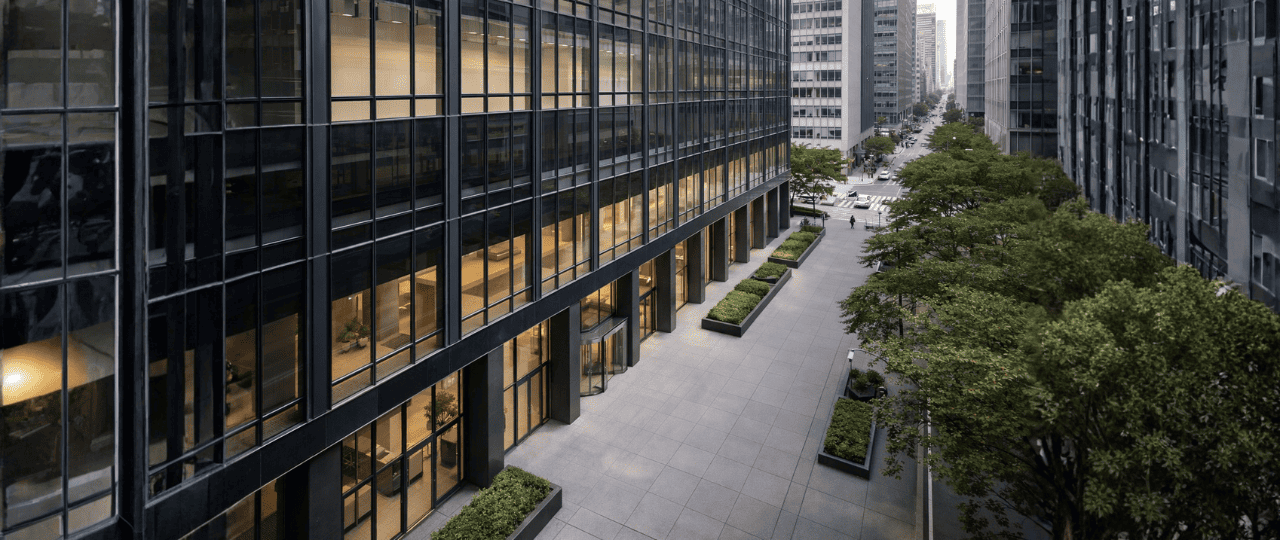
Site and perimeter is the starting point. How the property is approached and entered defines the outer layer of security. The assessment reviews entry and exit points, perimeter visibility, lighting conditions across different times of day, and natural movement patterns that may unintentionally guide people toward vulnerable areas. Identifying these conditions at the perimeter allows owners to address risk before it reaches interior spaces. This is the same principle that governs early security coordination in construction and renovation projects, where perimeter and access decisions made during design determine what is possible later.
Access control and internal movement covers how people move through the building once inside. Lobby controls, credential technology and configuration, elevator floor restrictions, stairwell access, and the separation between public and restricted areas are all reviewed against how the building is actually used rather than how it was designed to be used. In NYC's multi-tenant commercial buildings, vertical movement and shared lobby environments create access control challenges that are routinely underestimated during initial system design and rarely reassessed after occupancy patterns change.
Surveillance coverage and usability evaluates whether existing security cameras are providing actionable information or simply recording. The assessment reviews camera placement against actual sightlines, coverage of transitional spaces like elevator lobbies and stairwells that are consistently underserved, image quality under different lighting conditions, and whether footage would be useful during an investigation or response. The question is not whether cameras exist. It is whether they cover what matters and produce footage that can actually answer questions when needed.
Procedures and preparedness is the component most frequently overlooked when organizations think of security assessments as technology evaluations. Emergency communication methods, staff training, incident response protocols, and how those protocols align with the building's physical layout all directly affect outcomes during critical moments. A building with excellent camera coverage and a well-configured access control system that has never trained staff on response procedures is carrying a gap that no hardware investment addresses.
Documentation and reporting is the deliverable that gives an assessment its lasting value. Clear, prioritized documentation of identified risks and practical recommendations supports decision-making over time. It also creates the paper trail that matters when compliance audits, insurance reviews, or post-incident investigations ask what was known and when.
What a Security Assessment Is Not
Understanding the boundaries of an assessment clarifies how to use one productively. A security assessment is not a sales presentation. Its purpose is to identify gaps and support informed decisions, not to generate a system specification or a purchase order.
An assessment conducted by a firm that leads with equipment recommendations rather than risk findings is functioning as a sales tool, not a security evaluation. It is not a one-size-fits-all checklist. Generic assessment templates that apply the same criteria to a Class A Midtown office tower and a small professional services firm in a suburban building produce findings that are accurate in form and useless in practice.
A meaningful assessment is specific to the environment, occupancy, and operational patterns of the building being evaluated. It is not a guarantee. Assessments identify vulnerabilities and support risk reduction. They do not eliminate risk entirely or substitute for ongoing maintenance, staff training, and periodic reassessment as conditions change. And it is not a one-time exercise.
Security systems degrade without maintenance, building occupancy patterns shift, tenants turn over, and renovation projects change physical access conditions. An assessment provides a snapshot that is accurate when it is conducted. Buildings that treat an initial assessment as a permanent baseline rather than a starting point for ongoing evaluation will find that the gaps have returned by the time something prompts them to look again.

When Buildings Need a Commercial Security Assessment
Organizations typically seek assessments during periods of transition: moving into a new space, undertaking renovation or expansion, changing in occupancy mix, or responding to a specific security incident or concern that revealed a gap.
In New York City, assessments are also frequently initiated by buildings that have undergone significant changes since their original security design was implemented. A building that was designed for a single corporate tenant and now houses ten separate businesses has a fundamentally different access control challenge than its original system was built to address. The cameras, readers, and panels may all still be functional. Whether they are still appropriate is a different question that no one may have formally asked since the occupancy changed.
Healthcare facilities, hospitality properties, and commercial and business tenants in regulated industries also seek assessments when compliance frameworks require documented evidence that physical access controls are in place and being managed. SOC 2, HIPAA, and various financial services regulations all include physical security requirements. An assessment that produces clear documentation of the current posture and identifies any gaps provides the baseline that compliance reporting requires.
Common Misconceptions That Prevent Buildings From Getting Assessed
"We already have security systems." The presence of access control and cameras does not confirm adequate protection. It confirms that hardware was installed at some point. The assessment question is whether those systems are positioned correctly, configured appropriately, maintained to a functional standard, and aligned with how the building currently operates. A substantial share of buildings with complete-looking security infrastructure have meaningful gaps when evaluated against actual use.
"Assessments are only for high-risk buildings." Every commercial building carries some level of risk. The relevant question is whether that risk is understood and whether the current security posture is proportionate to it. Assessments scale to the environment. A small professional services office and a large multi-tenant commercial tower require different scopes and produce different findings, but both benefit from having a documented baseline.
"It's mainly about technology." Security outcomes are shaped by design, behavior, procedures, communication, and integration between systems. Technology is one element. An assessment that only evaluates hardware and ignores procedural gaps or the absence of staff training is an incomplete evaluation that will not identify some of the most consequential vulnerabilities.

The Relationship Between Assessment and System Design
The assessment is what makes everything that follows defensible. System design, equipment specification, and installation decisions that are grounded in a formal assessment of the building's actual risk profile produce systems that match operational reality. Those made without that foundation tend to match the installer's default configuration.
This is the principle behind why security assessment, engineering, and commissioning determine outcomes more than installation does. The quality of the planning before any hardware is specified determines what the system is capable of delivering. Installation executes that plan. Without the plan, installation is guesswork. For buildings that have had systems installed without a preceding assessment, a retrospective assessment is still valuable. It identifies whether what was installed matches what the building needs, surfaces any gaps in coverage or configuration, and produces the documentation baseline that supports ongoing management.
Connextivity'spast projectsinclude exactly this kind of inherited system evaluation across commercial, residential, and government facility contexts.
FAQs
How long does a commercial security assessment take for an NYC building?
Timeline depends on building size, complexity, and the number of systems to be evaluated. A straightforward single-tenant commercial suite can be assessed in a few hours with a written report delivered within a few days. A multi-tenant high-rise with existing access control, surveillance, and intercom infrastructure that all need to be evaluated takes considerably longer. Buildings requesting assessments as part of a compliance process, renovation planning, or insurance review should build three to four weeks into their timeline for a thorough assessment and documented deliverable.
What credentials should the person conducting a commercial security assessment hold?
At minimum, look for a Certified Protection Professional (CPP) credential from ASIS International, which is the most rigorous and widely recognized certification in the security management field. CPP holders have demonstrated competency in security assessments, threat and vulnerability analysis, risk management, and security program design through a formal examination process. For assessment work in New York City, the firm conducting the assessment should also hold NYS Department of State licensing for security system installation if the scope includes evaluation of installed systems that may require adjustment.
What does a security assessment report include?
A professional assessment report documents the assessment scope and methodology, identifies specific vulnerabilities organized by priority and area, provides context for each finding including the risk it represents and the conditions that created it, and outlines practical recommendations that can be phased based on risk priority and budget. The most useful reports are specific enough to support action rather than generic enough to apply to any building, and prioritized clearly enough that an organization with limited budget knows where to start.
How is a security assessment different from a security system installation proposal?
A security assessment is conducted independently of any equipment recommendation. Its output is a documented analysis of risk and gaps. A system installation proposal is a commercial document that specifies equipment and labor to be purchased. The two serve different purposes. An assessment should precede any installation proposal. An installer who leads with a product specification before conducting a formal assessment is providing a sales document, not a security evaluation. Organizations should be cautious of firms that skip or abbreviate the assessment and move directly to equipment recommendations.
How often should a commercial building's security be formally reassessed?
Annual reassessment is a reasonable baseline for most commercial properties, with additional assessments triggered by significant building changes including tenant turnover, renovation, changes to access control configuration, or security incidents. The goal of regular reassessment is to ensure that the documented security posture remains aligned with current building conditions rather than reflecting how the building operated when the last assessment was conducted. Buildings that have never had a formal assessment, regardless of how long their security systems have been in place, should treat the first assessment as a priority rather than a scheduled maintenance item.
Conclusion
A commercial security assessment is not about discovering that a building has failed at security. It is about establishing a documented, honest understanding of how the building is currently protected and where the gaps are before an incident makes those gaps impossible to ignore. For NYC building owners, property managers, and security-conscious tenants, the value of that clarity is not theoretical. Security vulnerabilities that are identified and documented during a formal assessment can be addressed deliberately, at a pace and cost that the organization controls. Vulnerabilities that are discovered during an incident are addressed under pressure, at significantly higher cost, after the consequences have already materialized. The most useful thing an assessment does is answer the question that matters most: does the current security posture actually match how this building operates?
Want to know how your commercial building's security posture holds up against how the building actually operates today?
Connextivity conducts security assessments for commercial properties across New York City, led by CPP-certified security professionals. We evaluate existing systems, identify gaps, and produce clear documentation that supports both immediate action and long-term planning. No equipment recommendation until the assessment is complete. Start with a security assessment.
Related Articles