
Access Control and Video Integration: Why NYC Buildings Need Both Working Together
Key Takeaways
Access control records that a credential was used. It does not confirm who actually used it. Video fills that gap.
Tailgating, shared badges, and lost credentials are common vulnerabilities that only become visible when access control and video are integrated.
Integrated systems shift security from reactive investigation to proactive monitoring, allowing teams to act on what is happening rather than reconstruct what already occurred.
For regulated environments, government facilities, and high-occupancy commercial buildings, video-verified access provides the audit trail and compliance documentation that standalone systems cannot.
Integration is a design decision, not a product purchase. It requires systems engineered to work together from the start.
A key card swipe tells you a door opened. It does not tell you who actually walked through it.
That gap is where a significant number of commercial security incidents originate. Shared credentials, lost badges, and tailgating are not rare edge cases. They are daily occurrences in high-occupancy buildings across New York City, and in buildings where access control and video operate as separate, disconnected systems, those incidents often go undetected entirely.
When access control and video surveillance are designed to work together, the picture changes. Every door event is paired with visual context. Security teams stop guessing and start seeing.
Why Standalone Systems Leave You Partially Blind
Access control systems, whether key cards, mobile credentials, or PIN codes, are effective tools for managing who is permitted to enter a space. But their fundamental limitation is that they verify a credential, not a person. A lost badge still opens a door. A shared access code still grants entry. A tailgater who follows someone through a controlled entrance leaves no record at all.
Video surveillance fills part of that gap by providing visual coverage, but without access event data attached to it, footage lacks actionable context. A camera can show someone walking through a door. It cannot confirm on its own whether that person was authorized, whether the credential used belonged to them, or whether the access event was flagged anywhere in the system.
When these two systems operate independently, security teams are left reconstructing events after the fact, often working with incomplete information under pressure.
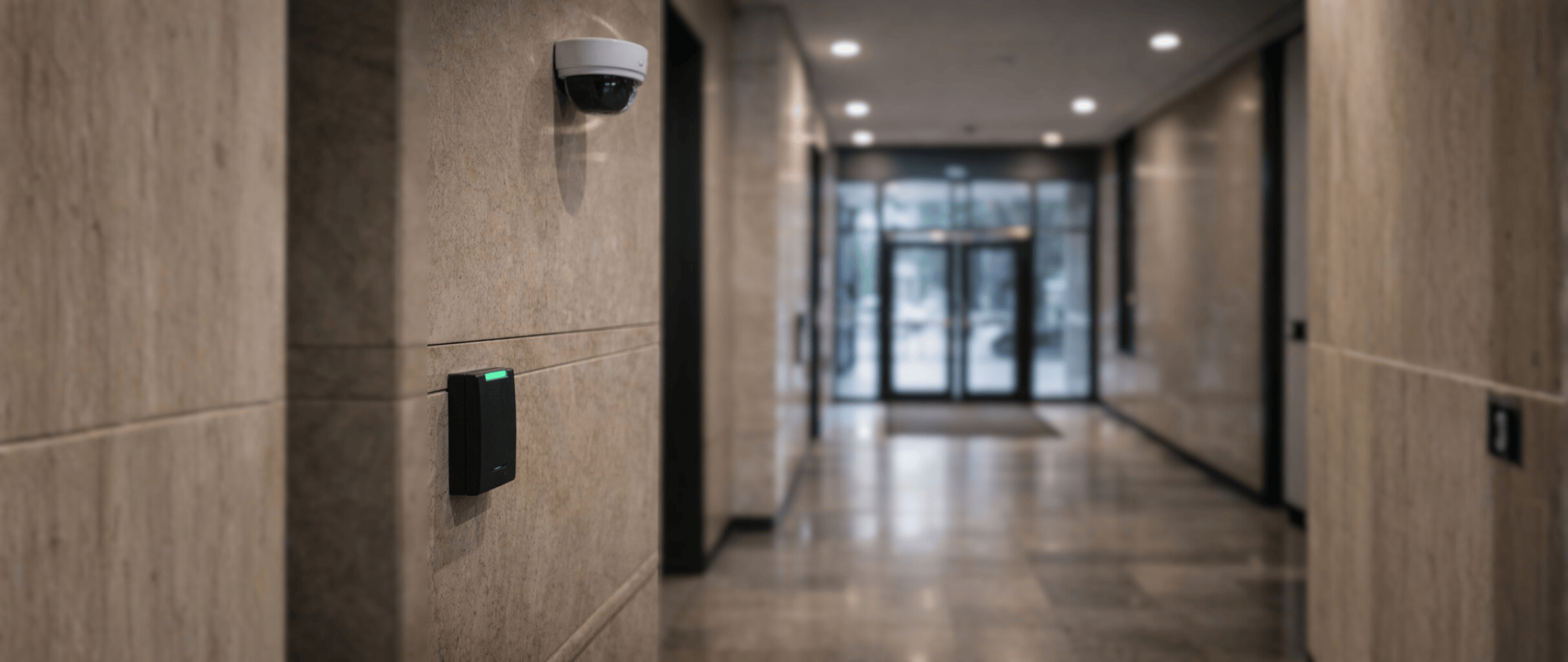
What Video Confirmation Actually Changes
When access control and video are integrated, each access event triggers a linked camera view. An "Access Granted" log entry is no longer just a timestamp and a credential ID. It becomes a timestamped clip showing exactly who entered, from which direction, and under what circumstances.
This connection changes how security teams manage risk in real time. During a live incident, it provides immediate clarity. During an investigation, it provides visual proof that is significantly stronger than an access log alone. And day to day, it makes patterns visible that would otherwise stay hidden.
Tailgating becomes apparent because the video shows two people entering on one credential swipe. Credential misuse becomes traceable because the face on camera does not match the badge holder. Unauthorized movement through controlled areas becomes documentable rather than theoretical.
Practical Benefits for NYC Commercial and Enterprise Buildings
For high-occupancy commercial buildings, office towers, and enterprise campuses in New York City, integrated video and access control supports several functions that standalone systems cannot reliably deliver.
Security staff can verify in real time whether the person using a credential matches who it was issued to, reducing the operational impact of lost or shared badges. Elevator access control in particular benefits from this integration, where vertical movement through a building can be tied directly to visual confirmation of who is moving and when.
Audit and compliance processes also improve significantly. For regulated environments and government facilities, attaching visual evidence to access logs creates a defensible record that holds up during reviews, incident investigations, and insurance assessments.

From Reactive Investigation to Proactive Awareness
One of the most significant operational shifts that integration creates is the move from reactive to proactive security.
In a system where access control and video operate separately, security teams typically discover a problem after it has already occurred, sometimes hours or days later. Integration makes unusual patterns visible as they unfold. A credential being used outside of normal hours. Multiple failed access attempts followed by a successful entry. Movement through a floor that a particular credential should not be able to access.
These signals exist in both systems separately. Integration is what makes them actionable in real time rather than interesting in hindsight. For buildings that have experienced incidents and are evaluating what went wrong, understanding why security cameras can become a liability when not properly integrated is a useful starting point for that conversation.

Integration Is a Design Decision, Not a Product Add-On
It is worth being direct about something: access control and video integration does not happen automatically just because both systems exist in the same building. It requires deliberate design choices about which platforms are used, how they communicate, and what events trigger what responses.
This is why the approach matters as much as the technology. Organizations that purchase access control and surveillance as separate products from separate vendors often discover that meaningful integration is difficult or impossible without replacing one or both systems entirely.
At Connextivity, access control and video are designed as components of a single security architecture from the beginning. That means the integration is built into the solution, not bolted on afterward. If you want to understand what that engineering process looks like before a project starts, the post on why early security coordination determines long-term system performance covers that in detail.
FAQs
What does "integrated access control and video" actually mean in practice? It means that when a door event occurs, such as an access granted or access denied, the system automatically links that event to footage from the nearest camera. Security staff can pull up the associated video clip directly from the access log without manually searching through footage. Some systems also allow live camera views to pop up automatically when a specific door or credential triggers a flag.
Does integration require replacing existing access control or camera systems? Not always, but it depends on what platforms are currently in place. Some legacy systems are compatible with modern integration middleware. Others are not, and integration may require upgrading one or both systems. A site assessment is the most reliable way to determine what your existing infrastructure can support before any decisions are made.
What types of NYC buildings benefit most from integrated access control and video? Any building with multiple controlled access points, high daily foot traffic, tenant turnover, or compliance requirements benefits from integration. This includes Class A office towers, mixed-use commercial buildings, healthcare facilities, government offices, and multi-tenant residential buildings. The higher the occupancy and the more complex the access patterns, the more value integration delivers.
Can integrated systems help with compliance and audit requirements? Yes. Many regulated environments require documented evidence of who accessed specific areas and when. An integrated system that links access logs to video footage creates an audit trail that is significantly more defensible than either data type on its own. This is particularly relevant for financial services firms, healthcare providers, and government contractors operating in New York City.
What is tailgating and how does video integration address it? Tailgating, also called piggybacking, occurs when an unauthorized person follows an authorized credential holder through a controlled door without using their own credential. Access control alone cannot detect it because only one credential swipe is recorded. When video is integrated, the footage tied to that access event will show two people entering on a single swipe, making the incident visible and documentable immediately.
Conclusion
Knowing a door opened is table stakes. Knowing who opened it, whether they were authorized, and whether anyone else came through with them is what operational security actually requires.
For NYC commercial building owners and property managers, the question is whether your current systems are giving you that full picture or just part of it. Access control and video integration is not a luxury feature for high-security environments only. It is the baseline standard for any building where accountability, compliance, and incident response matter.
If your access control and video systems are not talking to each other today, they are each doing half a job.
Wondering whether your access control and video systems are actually integrated or just installed in the same building?
There is a meaningful difference, and it is worth understanding before an incident makes it obvious. Connextivity designs integrated security systems for commercial buildings across New York City, from initial architecture through installation and long-term support.
Explore our access control services or contact ust o talk through what integration would look like for your building.
Related Articles
Professional Security Camera Installation NYC: What Building Owners Need to Know
Complete Guide to Access Control Systems in NYC: Solutions for Every Building Type
Speed Gates vs. Security Interlocks: Choosing the Right Entrance Control for Your NYC Building
Why Security Assessment, Engineering, and Commissioning Matter More Than Installation