
345 Park Ave Shooting: A Security Perspective on Prevention
Key Takeaways
Exterior cameras captured the shooter crossing the building's set-back plaza carrying a rifle before he entered the lobby. That footage was reviewed after the attack. Firearms detection analytics integrated with access control could have processed the same feed in real time and initiated a response before first contact.
Two security personnel were stationed in the lobby area. Both were shot before any lockdown was activated. The security station was not designed to give personnel a protected position or the time to respond. Front desk placement, ballistic protection, and panic button location determine whether a response is physically possible in the seconds available.
The shooter reached the 33rd floor via elevator without restriction. Credential-based elevator and floor access could have prevented this entirely. Once on the floor, he shot through the glass door to enter the office, a reminder that physical barriers need to be ballistic-rated to function as actual barriers, not just credential checkpoints.
Tenant companies at 345 Park notified their own employees separately during the incident. A building-wide mass notification system delivers a single coordinated alert across all channels simultaneously. Without one, communication fragments at the moment it needs to be clearest.
Since the 2025 Midtown Manhattan shooting, NYC commercial building owners have sought security assessments covering lobby design, exterior camera integration, access control, and turnstile configuration for both buildings in renovation and existing occupied properties.
We are deeply saddened by the tragic shooting at 345 Park Avenue on July 28, 2025, just a few blocks from our New York City office. Our thoughts remain with the victims and their families. Those killed were NYPD Officer Didarul Islam, Wesley LePatner, Aland Etienne, and Julia Hyman.
Now known as the 2025 Midtown Manhattan shooting, the attack occurred at 6:28 p.m. during business hours in one of the most occupied commercial corridors in the country. When the immediate shock passes, the professional responsibility is to ask what could reduce the likelihood of similar incidents in the future. This post is not about assigning blame. It is about understanding what failed and why, so that buildings across the city with the same vulnerabilities can begin addressing them.
According to the FBI's 2024 Active Shooter Incidents report, there were 24 designated active shooter incidents in the United States in 2024, down from 48 in 2023. That downward trend does not reduce the risk in high-density commercial environments. At 345 Park, multiple layers of security failed in sequence. Understanding where each layer could have intervened is the most useful contribution the security community can make.
The Cameras Saw It. The System Did Not Act.
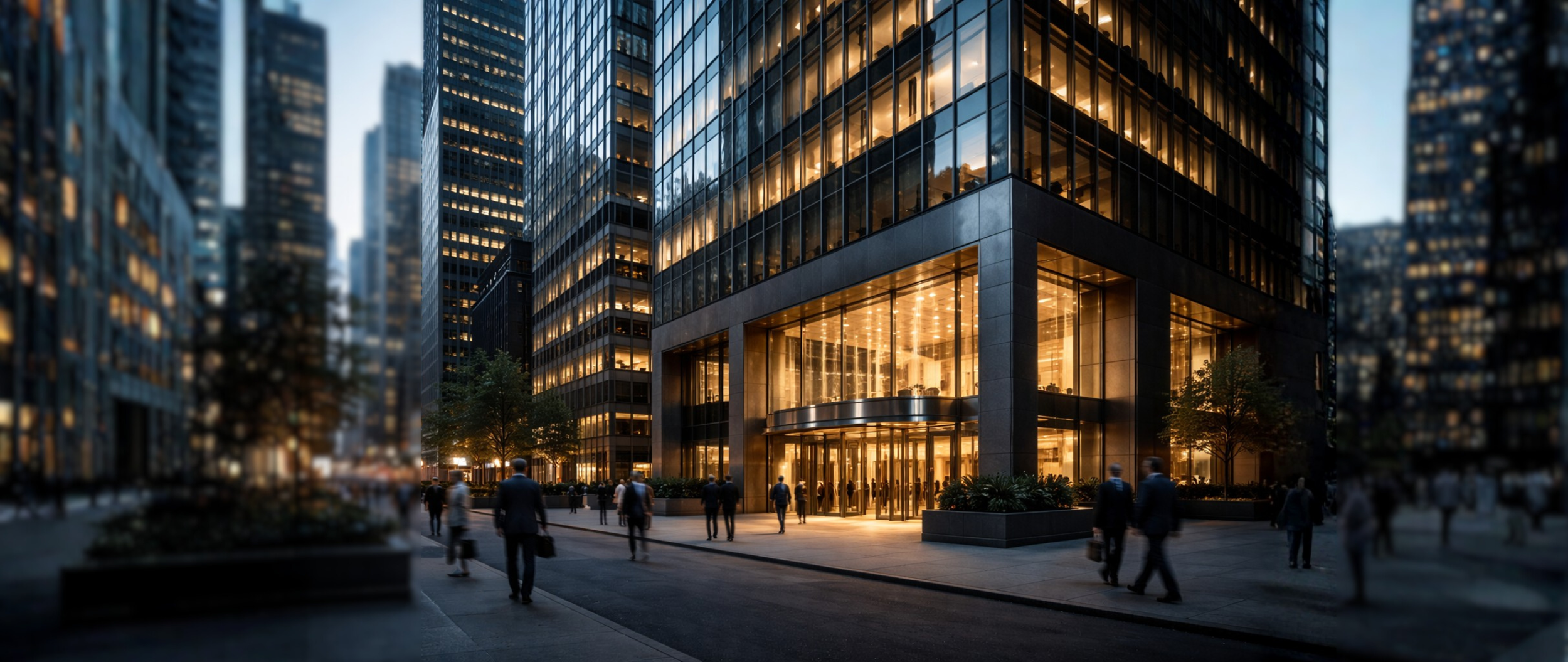
345 Park Avenue is set back from the street behind a broad open plaza. Surveillance footage released after the attack showed the shooter exiting a parked vehicle on Park Avenue, crossing that plaza, and entering the lobby with a rifle visible in his right hand during the entire approach. The exterior cameras captured all of it. That footage was reviewed after the attack. It was not used to prevent it.
This is the distinction that matters. Exterior camera coverage existed. What was missing was the integration that turns passive recording into active detection.
Visible firearms detection analytics analyze camera feeds in real time. When a weapon is identified, the system triggers a real-time alert and pulls up live video from the nearest camera so the security team has immediate visual context to assess the threat. From there, the team can initiate a partial or full lockdown through the integrated access control system. The workflow can also be configured to run automatically, so detecting a weapon triggers a lockdown without first requiring a human to confirm what the camera is showing.
Once a lockdown is activated, automated alerts can go out through the building's speaker system, mobile device messages, and audible in-building alarms. The security team can continue monitoring through the camera network and relay real-time information to first responders as they arrive. At 345 Park, the cameras recorded the threat approaching across the plaza in plain view. An integrated response chain would have turned that recording into a trigger.
The Lobby Was Not Set Up to Protect Security Personnel
Two security personnel were stationed in the lobby area. According to BBC reporting, the shooter initially walked past the first officer before turning, seeing him, and opening fire. Officer Didarul Islam, an off-duty NYPD officer working security in uniform, was fatally shot. The shooter then moved through the lobby, shooting additional people before reaching the elevator bank, where security guard Aland Etienne was also shot and killed. No lockdown was activated before the shooter reached the elevators.
Both individuals acted in the line of duty. The failure was not theirs. It was structural.
Most commercial building lobbies are designed for visitor experience. The security station is placed where it looks welcoming and is easy to find. What that placement rarely accounts for is what happens when someone enters with a weapon. If the security station is directly in the sightline of the main entry doors with no protective barrier between personnel and the entrance, there is no time and no cover. Security personnel are positioned to be encountered first, not to respond first.
The highest-impact change most buildings are not making is not a technology one. It is designing the security station to protect the people behind it. That means repositioning the desk for a lateral or offset view of arrivals rather than direct frontal exposure, with ballistic-rated glass at the counter and lockdown controls within reach from a protected position. Some of this can be accomplished within an existing layout. Some requires renovation. All of it needs to be assessed before it matters.

Unrestricted Vertical Access, and What Access Control Can and Cannot Stop
After the lobby, the shooter took the elevator to the 33rd floor without restriction. Investigators believe he intended to reach the NFL offices higher in the building but went to the wrong elevator bank. Regardless, he reached the 33rd floor unchallenged.
Credential-based elevator access control limits which floors a person can reach without an authorized credential. Without a valid access card, the elevator responds only to lobby-level requests. Anyone who enters the building cannot reach occupied upper floors without credentialing through the system. Combined with speed gates or turnstiles at the lobby level, these two layers create checkpoints at entry and at vertical access, the two points that determined how far the attack traveled.
One important clarification on the 33rd floor: once there, the shooter encountered a glass door at the Rudin Management reception area and shot through it to enter. A standard locked door would not have stopped this, and standard access control is not designed to stop someone who destroys the barrier to get through. Physical barriers need to be ballistic-rated to actually function as barriers against a shooter. Restricting elevator access to the floor would have prevented him from reaching that door entirely. But the broader lesson applies to the lobby counter, to reception areas on tenant floors, and to any physical barrier intended to slow or stop an armed intruder: the material matters as much as the lock.
Building-Wide Notification Was Missing
Individual tenant companies at 345 Park notified their own employees during the incident. At 399 Park Avenue next door, a coordinated building-wide alert was activated for its own occupants in response to the nearby threat. Based on video circulating from within both buildings, 399 Park delivered a unified message to everyone in the building at once. At 345 Park, each company was responsible for reaching its own people through its own channels.
A building-wide mass notification system delivers one alert simultaneously across all channels: email, text, mobile app, and audible in-building announcements. It is controlled from a single point, updated in real time as conditions change, and reaches every occupant at the same moment. A fragmented process, where each tenant company sends its own communications through its own approval chain, introduces delays, creates gaps for employees whose companies had no protocol ready, and adds confusion when clarity is most critical.
Mass notification systems are not new and not disproportionately expensive relative to other building security infrastructure. Their absence at 345 Park was a gap that existed long before July 28.

What NYC Buildings Are Asking For Now
The security conversations Connextivity has had with NYC commercial building owners since the 2025 Midtown Manhattan shooting fall into two tracks.
Buildings in renovation or active design phases are asking about security from the start: how lobby layouts should be structured for protection as well as function, what materials and finishes hold up in a security context, which type of turnstile suits their traffic volume and threat profile, and how cameras and access control get designed into the build rather than added afterward. These are the conversations that prevent a future building from carrying the same gaps into opening day.
Existing buildings work within what is already built. The questions shift to what a security assessment would reveal, which recommendations are achievable without full renovation, and which upgrades — cameras, turnstiles, elevator access control, panic alarms produce the most meaningful improvement given the specific building configuration.
In both cases, the starting point is the same: an honest evaluation of what the building currently provides against what it would actually face.

FAQs
Could better security have prevented the 345 Park Ave shooting entirely?
No system guarantees complete prevention. What layered security does is create barriers at multiple points and give personnel time to act. Several of those layers were either absent or not configured to slow the attack. That does not mean the outcome would certainly have been different, but the absence of those layers removed options that should have existed.
How does firearms detection analytics work when integrated with access control?
When a visible weapon is detected in a camera feed, the system triggers a real-time alert and surfaces live video from the nearest camera so the security team can immediately assess the situation. From there, the team can initiate a partial or full lockdown through the integrated access control system, or the system can be set to do this automatically. Once lockdown is activated, alerts go out through the building's speaker system, mobile messages, and audible alarms, and the camera network continues providing the team and first responders with a live view of the situation. At 345 Park, the exterior cameras recorded the approach across the plaza. An integrated response chain would have turned that recording into a trigger.
What does credential-based elevator access control actually prevent?
It prevents anyone without an authorized credential from reaching occupied floors above the lobby. Without a valid access card or credential, the elevator responds only to lobby-level requests. At 345 Park, the shooter reached the 33rd floor via elevator without restriction. Once on the floor, he shot through the glass door to enter the office, which a standard lock would not have stopped. Elevator floor restrictions would have prevented him from reaching that door at all, but the material quality of physical barriers matters alongside the credential layer.
What is a mass notification system and why was its absence significant at 345 Park?
A mass notification system delivers emergency alerts simultaneously across all building communication channels: email, text, mobile app, and audible in-building announcements, controlled from a single point and updated as conditions change. At 345 Park, each tenant company notified its own employees separately. The difference between a coordinated building-wide alert and a fragmented company-by-company notification process is measurable in seconds during an active incident.
What should building managers do first if they are concerned about these vulnerabilities?
Start with a professional security assessment. The gaps at 345 Park, exterior approach detection, lobby station design, elevator access controls, and mass notification, are all identifiable before they become relevant in an incident. An assessment establishes what the building currently provides and what the most impactful improvements would be given its specific layout and constraints.
Final Thoughts
No security system prevents every threat. The 2025 Midtown Manhattan shooting was not a case of one measure failing under circumstances no one could have anticipated. Exterior cameras recorded the approach and were not integrated into an active response. The lobby security station was positioned for visibility, not for protection. The floors above were unrestricted. Building-wide notification was absent. Each of those is a specific, addressable gap.
They are also not gaps unique to 345 Park. They exist in commercial buildings throughout Midtown and across the five boroughs. Some can be addressed within an existing layout. Others require renovation-phase planning. All can be identified before an incident through a professional assessment, which is the only point when findings are still actionable.
Is your building designed to respond in real time, or only to record what happened?
There is a meaningful difference between a camera system that documents events and one integrated with analytics and access control to act on what it sees. Connextivity conducts security assessments for commercial properties throughout New York City, covering lobby design, camera integration, access control, and emergency communication. Request a building security assessment.
Related Articles